
Compensatory vs. Punitive Damages: Understanding the Difference in Colorado Personal Injury Law
Compensatory vs. punitive damages: understanding the difference is vital for any accident victim who wants to ensure their legal settlement actually covers the true cost of their recovery. While both terms refer to financial awards in a lawsuit, they serve entirely different masters. One looks backward to repair what was broken, while the other looks forward to prevent a similar tragedy from ever happening again.
At Colorado Accident & Injury, we see firsthand how these damages impact our patients’ lives. Our integrated team helps patients navigate financial and legal challenges by providing the bulletproof medical evidence required to justify every dollar of your claim.
1. The Core Focus: Compensatory Damages
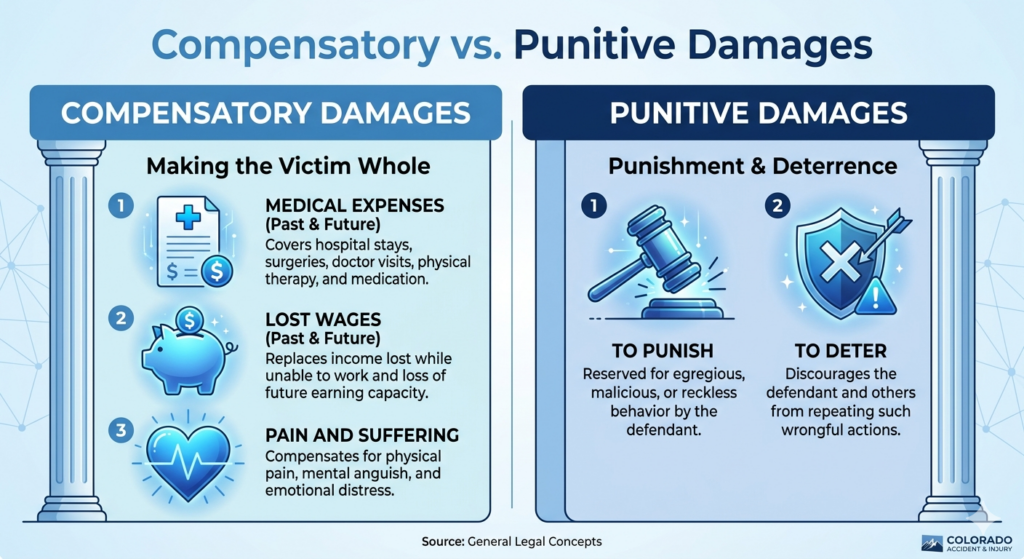
Compensatory damages are the most common form of recovery. Their purpose is simple: to make the victim “whole” again. In a perfect world, this money would undo the accident. Since it can’t, it provides the financial equivalent of the life you had before the injury.
A. Economic Damages (The Tangible Costs)
These are the “hard” costs that come with a receipt or an invoice.
- Medical Expenses: This includes everything from the initial ER visit to ongoing Chiropractic Care. We document every adjustment to ensure your future medical needs are fully funded.
- Lost Wages: If you cannot work, you are entitled to the income you lost, plus “loss of earning capacity” if your injury permanently changes your career path.
B. Non-Economic Damages (The Intangible Costs)
These are “soft” costs that don’t have a fixed price tag but are often the most devastating.
- Pain and Suffering: Proving this requires a consistent record. Attending regular Best Physical Therapy Services creates a clinical log of your struggle and effort to recover.
- Loss of Enjoyment: This compensates you for the inability to participate in hobbies, like hiking the Colorado trails or playing with your children.
2. The Deterrent: Punitive Damages
When discussing Compensatory vs. punitive damages: understanding the difference, punitive damages are the exception, not the rule. They are not about your losses; they are about the defendant’s “evil” or “reckless” behavior.
When are they awarded?
In Colorado, punitive damages (also called “exemplary damages”) are only awarded if the defendant acted with:
- Fraud or Malice: Intentional deceit or a desire to cause harm.
- Willful and Wanton Conduct: A complete and total disregard for the safety of others—such as a drunk driver going 100 mph in a school zone.
3. Key Differences at a Glance
| Feature | Compensatory Damages | Punitive Damages |
| Primary Goal | To make the victim whole | To punish and deter |
| Frequency | Awarded in almost all winning cases | Rarely awarded; reserved for extreme cases |
| Evidence Needed | Proof of actual loss and injury | Proof of “willful and wanton” behavior |
4. Colorado’s Legal Caps and Limits
It is important to know that Colorado law often places “caps” or limits on damages to prevent runaway jury awards.
- Punitive Cap: Generally, punitive damages cannot exceed the amount of compensatory damages awarded. If you receive $100,000 for your injuries, the punitive award is usually limited to $100,000 as well.
- Non-Economic Cap: Colorado has specific statutory limits on how much a person can receive for “pain and suffering,” which adjust periodically for inflation.
5. Why Clinical Documentation is the “Gavel”
Regardless of the type of damages you seek, the strength of your case depends on medical facts.
- Proving Emotional Distress: By utilizing Massage Therapy to treat physical manifestations of PTSD—such as chronic muscle guarding—we help provide a physical link to your emotional suffering.
- The Expert Narrative: Our doctors act as expert witnesses. We don’t just say “it hurts”; we explain the biomechanical reason for the pain and why the defendant’s actions caused permanent damage.

6. Navigating the Legal Complexities
Compensatory vs. punitive damages: understanding the difference is just the beginning. Actually securing these funds requires a team that understands how insurance companies think. Adjusters will often try to “settle” for your economic costs while ignoring your non-economic pain. Having a team that documents every facet of your recovery—physical, emotional, and financial—makes it much harder for them to lowball your settlement.
7. Recovering More than Just Money
At Colorado Accident & Injury, we believe the ultimate “damage award” is a full recovery. While we work with your legal team to maximize your financial compensation, our primary focus is restoring your mobility and quality of life. Whether through advanced Chiropractic Care or specialized rehabilitation, our goal is to get you back to the life you loved before the accident occurred.
Don’t leave your compensation to chance. Understanding your rights is the first step, but having the right medical team is what secures them. At Colorado Accident & Injury, we provide the elite documentation and integrated care you need to win.