
Crucial Steps for Hit-and-Run Victims: Protecting Your Health and Your Rights When a Driver Flees
Crucial steps for hit-and-run victims begin the very second the other driver leaves the scene. Being involved in a hit-and-run accident is a uniquely violating experience. Beyond the physical trauma of the impact, victims are left with a sense of helplessness and the daunting question of who will pay for their recovery. In Colorado, hit-and-run incidents are treated with extreme severity by law enforcement, but the burden of initial documentation and medical action falls on the victim.
At Colorado Accident & Injury, we specialize in helping patients who feel they have nowhere to turn. Whether the responsible party is eventually found or not, your path to physical and financial restoration depends on the actions you take in the minutes and hours following the crash.
1. Prioritize Immediate Safety and Assessment
The shock of a hit-and-run can cloud your judgment. Your first move must be to secure your environment. If your vehicle is in the middle of a busy thoroughfare like I-25 or Powers Blvd, move to the shoulder if it is safe to do so. Turn on your hazard lights immediately to alert other drivers.
Once stationary, perform a “self-check.” High-stress events trigger a massive surge of adrenaline that can mask broken bones, internal bleeding, or severe whiplash. Check your passengers for signs of shock or disorientation, which are common indicators of a concussion.
2. The Power of Documentation: Information is Your Currency
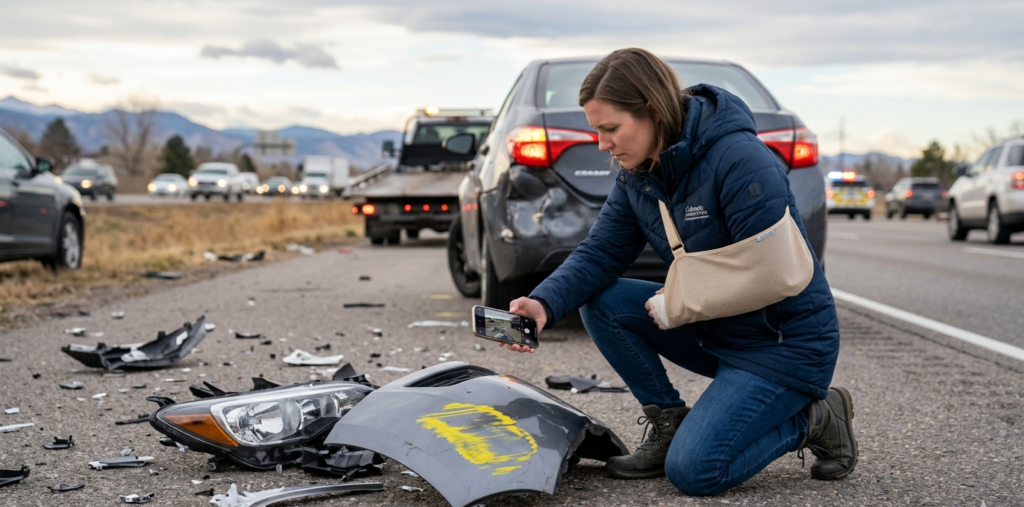
Because the other driver is absent, the physical evidence at the scene is your only leverage. While your memory is fresh, write down or record a voice note of everything you saw:
- The Vehicle: Make, model, color, and any unique features like bumper stickers or dents.
- The Plate: Even a partial license plate or the state of origin (e.g., “it was a white Colorado plate with a ‘7’ in it”) is vital for police.
- The Driver: Any description of the person behind the wheel.
- The Direction: Which way did they flee?
3. Involving Law Enforcement Immediately
Calling 911 is one of the most crucial steps for hit-and-run victims. A formal police report is the cornerstone of your insurance claim. Without it, your insurance provider may be skeptical of your version of events. When the officer arrives, ensure they note any paint transfer from the other vehicle or debris left behind. These forensic details are often how hit-and-run drivers are eventually caught at local repair shops.
4. Resisting the Urge to Pursue
It is a natural human instinct to want justice, but chasing a fleeing driver is never the answer. Pursuing a hit-and-run suspect can lead to a secondary high-speed collision or a dangerous physical confrontation. Stay at the scene. Your safety and the preservation of evidence are far more valuable than a high-stakes chase.
5. Navigating the Insurance Maze: UM and UIM Coverage
If the driver is never found, how do your bills get paid? This is where your own policy’s Uninsured Motorist (UM) or Underinsured Motorist (UIM) coverage becomes your lifeline. In Colorado, these coverages are designed specifically for this scenario.
- Contact Your Carrier: Notify them immediately.
- The “Gap” Trap: Insurance adjusters may try to settle quickly before the full extent of your Chiropractic Care needs are known. Because our clinic helps patients navigate financial and legal challenges, we provide the medical necessity documentation required to ensure your own insurance treats you fairly.
6. Seeking Medical Evaluation: The 72-Hour Rule
Even if you believe you escaped “unscathed,” you must see a specialist. Injuries like “tech-neck” whiplash or soft tissue micro-tears are notorious for delayed onset. To protect your claim, you should ideally have a medical evaluation within 72 hours.
Our team provides comprehensive screenings, including Massage Therapy to manage acute muscle spasms and Best Physical Therapy Services to begin restoring your range of motion. Documentation from a specialist clinic like ours proves that the injury was a direct result of the crash, preventing the insurance company from claiming your pain was a pre-existing condition.
7. Partnering with a Personal Injury Specialist
A hit-and-run case is a legal “heavy lift.” You need a team that understands how to pull surveillance footage from nearby businesses and work with investigators to find the culprit. While your attorney handles the hunt for the driver, our medical team handles the restoration of your body. This two-pronged approach ensures that you aren’t just a “case number” but a person on the road to a full recovery.
8. The Psychological Impact of a Hit-and-Run
Being left at the scene of an accident creates a specific type of emotional trauma. It is common for victims to experience heightened anxiety, fear of driving, or even PTSD. Part of our crucial steps for hit-and-run victims involves a holistic approach. We address the physical pain that keeps you in a “stress loop” and provide a supportive environment that acknowledges the mental toll of the incident.
You Are Not Alone on Your Road to Recovery Being a victim of a hit-and-run is overwhelming, but your recovery doesn’t have to be. Let our experts provide the medical care and documentation you need to move forward with confidence.