
Chiropractic Spinal Decompression: Non-Surgical Relief for Post-Crash Spinal Trauma
During an automobile accident—even one that occurs at low speeds and does not feel like a major event—your body can be thrown about the cabin of your vehicle with immense force. The violent kinetic energy of a crash routinely results in severe musculoskeletal injuries, including deep bruising, fractures, neck whiplash, complex lacerations, and traumatic brain injuries. Left untreated, the chronic pain trailing these physical injuries frequently leads to secondary psychological challenges, including clinical depression.
A severe impact also commonly creates a persistent feeling of deep structural discomfort that stems from a sudden, violent compression of the spine. While it may sound as though axial compression requires a very specific type of movement, it is rarely an issue that impacts the entire spinal column evenly. Instead, a targeted portion of your spine absorbs the brunt of the impact, subjecting localized vertebrae to severe compression. Because of how forces travel through a vehicle cabin, this specific type of internal trauma is far more common than most accident survivors realize.
At Colorado Accident & Injury, our multi-disciplinary medical team helps patients navigate financial and legal challenges while providing advanced Medical Pain Management options. We recognize that axial compression can severely disrupt your nervous system. Utilizing advanced, computerized spinal decompression therapy allows us to safely reverse this mechanical pressure, protecting your physical longevity and restoring your quality of life without invasive surgical interventions.
The Internal Mechanics of Compression and Pain
When the physical structures of your back are compressed during a crash, debilitating pain can result from several distinct mechanical factors:
- Pinched Nerve Roots: Misaligned structural elements can physically trap or pinch a delicate nerve root, sending severe, radiating pain signals directly to your brain based on your posture or movement.
- Bone-on-Bone Friction: The natural protective space between your vertebrae can collapse, causing bones to rub against other bones every time you twist, bend, or walk.
- Herniated and Ruptured Discs: The extreme pressure can force a spinal disc seriously out of its proper alignment, causing a rupture or herniation of the flexible, fluid-filled cushion that lies between each vertebra.
- Severe Muscle Guarding: The deep muscles supporting your back will involuntarily seize and contract in a defensive attempt to brace the compressed, unstable region of the spine.
The Clinical Anatomy of Your Spine
From an anatomical perspective, the human spinal column is divided into four primary structural regions:
- Cervical Spine: The 8 specialized vertebrae supporting your neck and controlling head mobility.
- Thoracic Spine: The 12 vertebrae anchoring your upper back and rib cage.
- Lumbar Spine: The 5 larger, heavy-duty vertebrae comprising your lower back.
- Sacral & Coccygeal Regions: The 5 fused segments forming the sacrum and the coccyx (tailbone) at the base of the column.
Pathological compression is normally concentrated within the three higher regions: the cervical, thoracic, and lumbar spine. These specific portions of the skeletal framework perform all of the heavy physical lifting for your body, working continuously to hold your torso, chest, and head in proper structural alignment.
Comparing Mechanical Approaches to Decompression Therapy
| Decompression Methodology | Clinical Application & Mechanics | Patient Experience & Efficacy |
| Manual Gravity Traction | Suspension from a specially devised shoulder harness, allowing the weight of your legs and lower torso to pull down on the spine. | Inexact tension control; can trigger involuntary muscle guarding if the patient is unable to fully relax. |
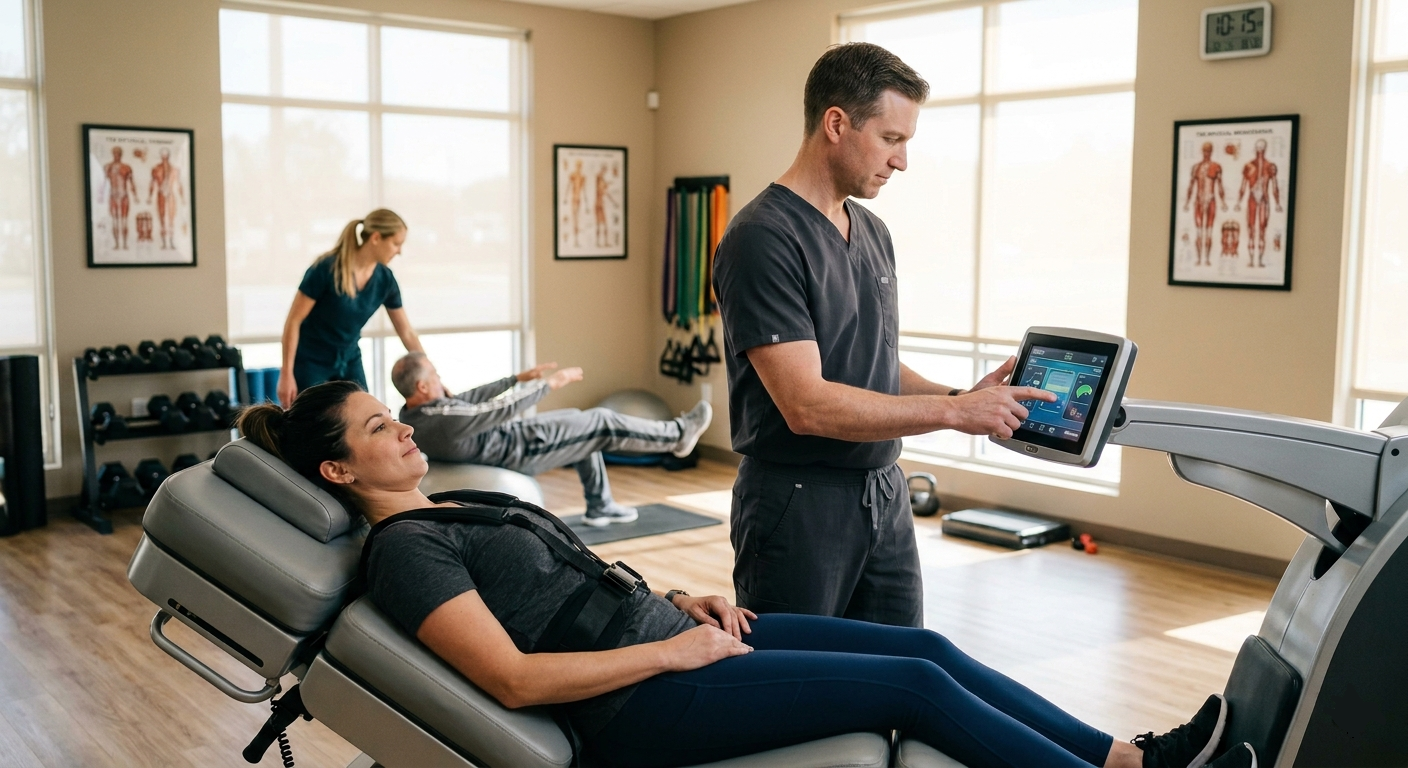
| Computerized Table Decompression | Fully clothed patient is secured via precision waist and leg harnesses onto a motorized, computer-assisted traction table. | Highly Recommended. Gentle, precise, and targeted pulling forces that bypass muscle resistance to stretch specific spinal segments. |
What to Expect During a Decompression Treatment Plan
Clinical outcomes demonstrate that most patients require between 1 and 10 targeted sessions of decompression therapy to achieve lasting structural stabilization. During a standard, highly controlled session at our doctor’s office—which typically lasts between 15 and 45 minutes—you remain fully dressed. The specialized computer-assisted harness applies a gentle, logarithmic distraction force, gently stretching your spine to actively eliminate the compression.
The localized results of a decompression session can vary based on the chronicity of your injury, but a vast majority of patients feel immediate, profound relief during their very first session. This instant relief occurs because the pulling force immediately removes mechanical pressure from a trapped nerve root or allows a bulging disc to draw back into its proper boundaries.
However, while most patients experience immediate comfort, there is a distinct clinical chance that your pain may temporarily return after a few hours, or within a day or two. When this occurs, it means the surrounding soft tissues are still adapting to the proper alignment. It is highly recommended that you undergo a consistent series of sequential treatments until the therapeutic decompression forces begin to hold for exponentially longer periods of time.
Once your acute crash injuries are fully resolved, many patients choose to transition into a preventative maintenance routine. Returning for a periodic check-up and decompression session once or twice a year is an excellent strategy to keep your spine perfectly aligned, preserve your flexibility, and prevent daily gravity from compressing your back in the future.
A Unified, Multi-Discipline Approach to Whole-Body Recovery
Successfully reversing severe automotive trauma requires a synchronized approach to physical medicine. Our Colorado Springs healthcare facility brings a fourteen-member team of specialists together under one address to ensure your treatments operate in perfect harmony:
- Expert Chiropractic Care: Works hand-in-hand with computerized tables to ensure vertebrae are gently guided back into their proper alignments once joint spaces are decompressed.
- Best Physical Therapy Services: Introduces active, targeted conditioning exercises to strengthen the deep core and stabilizing back muscles, ensuring your spine maintains its newly restored height and spacing over the long term.
Protecting Your Personal Injury Claim with Forensic Records
For accident survivors, securing active physical care at an integrated clinic is just as vital for your financial protection as it is for your physical recovery. Personal injury lawyers and insurance adjusters evaluate post-crash medical charts with immense scrutiny.
If your medical records show only a passive reliance on painkillers with no active intervention to correct a herniated disc, insurance companies will frequently argue that your injuries are minor or pre-existing, using the lack of active care to downplay your personal injury settlement. Our specialized medical team meticulously documents your exact spinal distraction metrics, nerve decompression responses, and functional range-of-motion improvements from day one, providing your legal counsel with the ironclad forensic evidence needed to push your insurance claims smoothly through complex administrative hurdles.
Conclusion
You do not have to accept chronic back stiffness, radiating nerve pain, or passive pharmaceutical dependence as your only options after a car crash. Utilizing advanced spinal decompression allows you to safely reverse internal impact forces and restore your natural structural alignment. If you are involved in a collision, always prioritize calling 911 or emergency services first to guarantee immediate scene safety. Once your scene safety is fully secured, make your very second call to Colorado Accident & Injury at 719-917-1000 to schedule a comprehensive diagnostic evaluation with our integrated team. Keep our phone number handy, and let our fourteen-member expert team handle your recovery with the precision, care, and dignity you deserve.
Open the Joint Space. Relieve the Nerve. Heal the Disc.
Do not let post-crash spinal compression permanently compromise your mobility or nerve health. Contact our unified multi-discipline clinic today for computerized decompression therapy and expert injury documentation.