
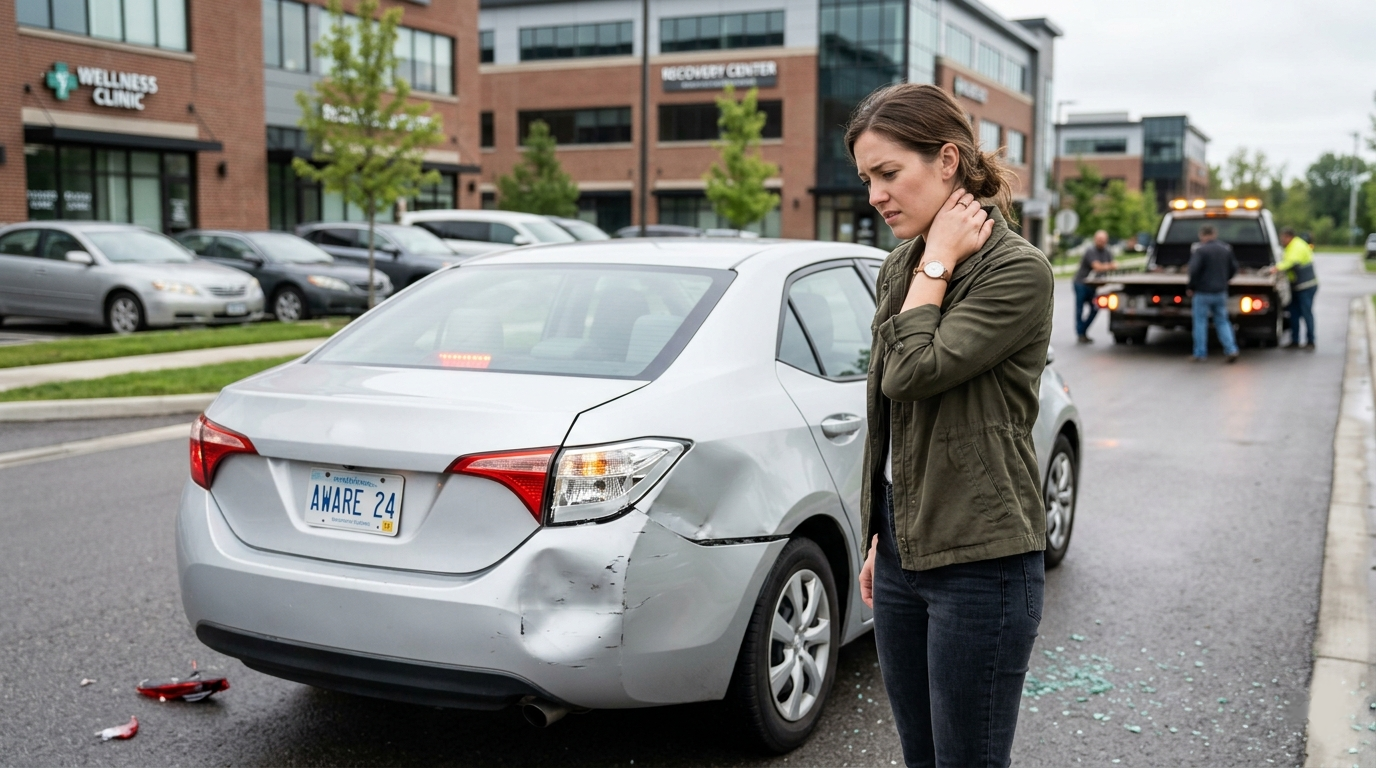
Car Accidents Have Delayed Symptoms: What to Look For and How to Act
Many individuals who walk away from a motor vehicle collision do so feeling extraordinarily lucky that they were not severely injured. They easily arrive at this conclusion because, although their bodies feel understandably “banged up” from the force of the impact, they do not experience any immediate pain or physical discomfort significant enough to send them to an emergency room or a medical clinic.
In many cases, an investigating police officer, a concerned passenger, or a witness at the scene will strongly urge them to seek immediate medical attention. “With a collision like that, you really should go see a doctor,” they might advise.
Yet, in the complete absence of significant, overt pain, these motorists frequently wave off the suggestion to get medical help. This can turn out to be a massive mistake. Choosing to see a doctor after a minor car accident at a dedicated multi-discipline facility is the single most proper and reliable way to identify and document hidden structural conditions before they escalate.
At Colorado Accident & Injury, our multi-disciplinary medical team helps patients navigate financial and legal challenges while providing advanced Medical Pain Management options. Many severe, life-altering injuries are characterized by delayed symptoms that remain completely masked during the initial hours following a crash. Falling into the trap of assuming that delayed discomfort is less serious than immediate pain can severely compromise your long-term health and your legal rights.
The Physiological Trap of Hidden Post-Crash Damage
The secondary trap people frequently fall into regarding post-accident care is the assumption that symptoms showing up days or weeks after a collision are minor. However, a slow-developing physical reaction does not mean the underlying trauma is not real, significant, or highly dangerous.
Certain neck injuries can easily gravitate from moderate to permanently debilitating if the cervical spine is not stabilized right away. Treating potential head trauma in a timely manner is a critical factor in ensuring a complete, robust recovery.
If you or a loved one have recently survived an impact, you must monitor your body for these common conditions:
1. Delayed-Onset Headaches and Concussions
Mild to moderate concussions and traumatic brain injuries routinely fail to present symptoms right after a collision. Because internal swelling or slow bruising within the brain tissue takes time to accumulate fluid, the resulting headaches are rarely obvious at the scene of the accident.
- What to Look For: Pay close attention to sudden mood shifts, unprovoked insomnia, loss of appetite, blurred vision, persistent nausea, and a heightened sensitivity to bright light or physical touch.
2. Hidden Whiplash and Soft-Tissue Inflammation
Whiplash is a frequent driver of post-accident headaches. The sudden mechanical jolt of a crash violently tears and strains the deep muscles and ligaments supporting the head, causing severe, localized tension. The chemical inflammation triggered by whiplash is notoriously slow to develop, creating a long window of delayed pain.
- What to Look For: Monitor your system for shooting pain across the neck, shoulders, and back, as well as localized stiffness, soreness, overall body aches, sudden vision changes, and physical restrictions to your normal range of motion.
3. Post-Traumatic Stress Disorder (PTSD)
An automobile accident introduces an immense, sudden wave of emotional and psychological trauma to your nervous system. PTSD is an incredibly common condition for crash survivors, and it can even manifest in third-party witnesses who observed the violent impact from a distance.
- What to Look For: Watch for swiftly changing moods, elevated daily anxiety, and vivid nightmares. PTSD frequently manifests as a severe overreaction to everyday events—such as someone dropping a heavy package that makes a sudden sound, which instantly triggers a psychological reminder of the loud crashing sound of the accident.
The Comprehensive Post-Collision Symptom Checklist
If you experience any of the following physical or cognitive changes in the days or weeks following a collision, you must contact an automobile accident medical specialist immediately:
| Symptom Category | Specific Warning Signs to Monitor |
| Physical & Structural | Unexplained pain in the neck, shoulders, or back; abdominal pain; sudden bruising. |
| Neurological & Sensory | Dizziness; tingling sensations or numbness in the limbs; changes in vision; hearing loss or tinnitus. |
| Cognitive & Sleep | Difficulty concentrating or processing info; memory glitches; insomnia; extreme fatigue. |
Reclaiming Whole-Body Health Through Integrated Care
Overcoming complex post-crash trauma requires a holistic, unified approach to physical medicine. Our Colorado Springs healthcare facility integrates multiple distinct clinical specialties under one roof to address your healing from every angle:
- Best Physical Therapy Services: Vital for actively tracking your functional range-of-motion metrics, flushing out delayed soft-tissue inflammation, and utilizing controlled active conditioning to stabilize joints that are overcompensating for an injury.
- Expert Chiropractic Care: High-velocity car accidents often leave victims suffering from a vague, generalized pain. Expert chiropractic evaluations routinely reveal that this systemic discomfort stems from spinal misalignments. Gentle manual adjustments safely realign your vertebrae, removing structural pressure from irritated nerve roots to instantly resolve post-traumatic headaches and chronic neck stiffness.
Ironclad Forensic Documentation for Your Claims Journey
Seeking an immediate clinical diagnosis from an integrated team is just as vital for your financial protection as it is for your physiological health. Personal injury attorneys and insurance adjusters evaluate medical records with extreme scrutiny.
If you delay your medical visit, opposing insurance adjusters will certainly question the severity of your injuries, arguing that your physical complications were caused by an entirely separate event. Our specialized team meticulously logs your diagnostic findings, functional movement limitations, and therapeutic milestones from day one, providing your legal counsel with the powerful asset needed to help your insurance claims progress smoothly.
Conclusion
Never assume that a lack of immediate pain at the scene of a crash means your body escaped unharmed. Protect your physical longevity and secure your legal rights by letting professionals thoroughly evaluate your system for delayed symptoms. If you are involved in a collision, always prioritize calling 911 or emergency services first to guarantee immediate scene safety. Once you are safe, call Colorado Accident & Injury at 719-917-1000 to schedule a comprehensive diagnostic evaluation with our fourteen-member expert team. Let our specialists protect your health and document your recovery flawlessly from the start.
Some Injuries Take Days to Hurt. Don’t Wait for the Pain.
Protect your physical mobility and secure your legal claims. Contact our unified multi-discipline clinic today for advanced post-accident diagnostics and expert injury documentation.