
Do You Have a Strong Personal Injury Claim? Evaluating the 4 Pillars of Success
Do you have a strong personal injury claim? This is the fundamental question that determines whether you will receive the financial support necessary to recover or be forced to pay for someone else’s negligence out of your own pocket. A “strong” claim isn’t just about being injured; it’s about the intersection of law, medicine, and evidence. In Colorado, insurance companies are highly skilled at devaluing claims by attacking small inconsistencies in your story or your medical history. To win, your case must be built on a foundation of undeniable facts.
At Colorado Accident & Injury, our integrated medical and legal support team helps patients navigate financial and legal challenges by ensuring every physical injury is matched with the clinical documentation required to stand up in court.
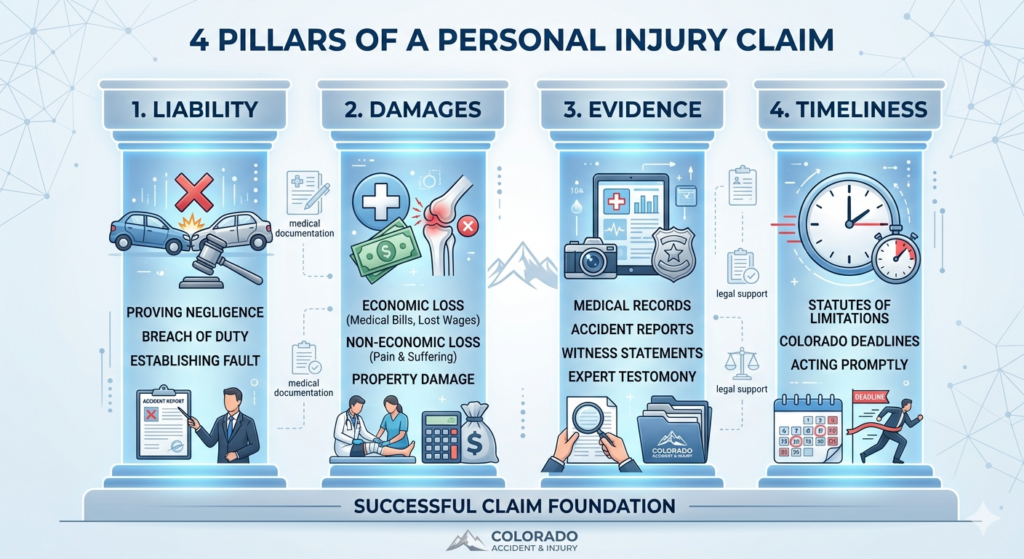
1. Pillar One: Establishing Clear Liability
The first step in determining, “Do you have a strong personal injury claim?” is looking at fault. You must prove that the other party owed you a “duty of care” and failed to meet it.
- The Breach: Did the driver run a red light? Did the store owner leave a spill on the floor for three hours?
- Proximate Cause: You must prove that the specific breach of duty was the direct cause of your injury. If you had back pain before the accident, we must use diagnostic imaging to show how the accident specifically made it worse.
2. Pillar Two: Proving Significant “Damages”
In legal terms, “damages” refers to the losses you’ve suffered. If you were in a minor fender bender but walked away with zero physical or emotional trauma, you don’t have a claim.
- Economic Damages: These are the easy-to-track costs like hospital bills, medication, and lost wages.
- Non-Economic Damages: This is where many claims gain their value. It includes your physical pain, emotional distress, and loss of quality of life. By utilizing Massage Therapy to document acute muscle guarding and stress-related tension, we provide the “subjective” proof needed for pain and suffering.
3. Pillar Three: The Quality of Your Evidence
Evidence is the “ammunition” of your claim. A case with fuzzy photos and no witnesses is weak. A case with high-resolution scene photos, a detailed police report, and expert medical testimony is strong.
- Objective Medical Findings: This is our specialty. When we identify a spinal misalignment through Chiropractic Care, we aren’t just giving you an adjustment; we are creating a permanent medical record of your injury that an insurance adjuster cannot ignore.
4. Pillar Four: Consistency in Treatment
Insurance adjusters look for “gaps in treatment.” If you claim your neck is in excruciating pain but you skip three weeks of therapy, they will argue you aren’t actually hurt.
- The Power of the Log: Attending every session of Best Physical Therapy Services creates a “functional timeline.” It shows that you are working hard to recover and that your injuries are severe enough to require professional intervention.
5. Understanding Colorado’s Specific Timelines
Do you have a strong personal injury claim? Not if the clock has run out. Colorado has strict “Statutes of Limitations.”
- General Personal Injury: 2 Years.
- Motor Vehicle Accidents: 3 Years. If you wait until the last minute to seek care, the “strength” of your claim diminishes because it looks like a litigation tactic rather than a medical necessity.
6. The Role of the “MMI” (Maximum Medical Improvement)
A claim is at its strongest when your medical team can state exactly what your future looks like. We wait until you reach Maximum Medical Improvement—the point where your healing has plateaued—before we finalize your medical narrative. This ensures that if you need Pain Management for the next ten years, that cost is included in your settlement demand.

7. Comparative Negligence: The “50% Rule”
Colorado follows a “modified comparative negligence” model. This means you can still have a strong claim even if you were partially at fault—as long as you were less than 50% responsible. For example, if you were speeding slightly but the other driver turned left in front of you, you may be found 20% at fault. Your total compensation would simply be reduced by 20%.
8. Why Expert Testimony Changes the Game
When a claim goes to mediation or trial, the insurance company will bring their own “doctors” to say you are fine. You need a counter-weight. Our providers act as expert advocates, explaining the biomechanics of your injury in a way that a jury can understand. We translate your pain into a clinical language that demands a fair settlement.
Stop Guessing and Start Healing Determining the strength of your claim shouldn’t be a DIY project. At Colorado Accident & Injury, we provide the integrated medical and legal insights you need to understand the true value of your case. Let us build the evidence while you focus on getting back on your feet.