
Do Pre-existing Injuries Impact Personal Injury Claims? Navigating the “Aggravation” Path to Fair Recovery
Do pre-existing injuries impact personal injury claims? This is one of the most common questions we hear from patients who walk through our doors after a car accident. There is a persistent myth that if you already had a “bad back” or a “trick knee” before a crash, you lose your right to seek compensation. In reality, Colorado law recognizes that accident victims are not always in perfect health at the time of a collision. In fact, a new injury often has a much more devastating effect on a body that is already compromised.
At Colorado Accident & Injury, we specialize in the meticulous diagnostic work required to separate pre-existing conditions from new trauma. We don’t just treat the pain; we provide the clinical evidence necessary to prove how an accident “aggravated” or “exacerbated” your previous health status.
1. The Legal Reality: The “Eggshell Skull” Rule
In personal injury law, there is a fundamental principle known as the “Eggshell Skull Rule.” It states that a defendant must take the victim as they find them. If a person has a skull as fragile as an eggshell and a minor impact causes a major injury, the at-fault driver is still responsible for the full extent of the damage. Do pre-existing injuries impact personal injury claims? Yes, but usually by making the claim more significant because the impact on your life is greater.
2. Aggravation vs. Exacerbation: Why the Terms Matter
When we document your recovery, our medical team uses specific clinical language that insurance adjusters and attorneys rely on:
- Aggravation: This occurs when an accident takes a dormant, stable, or asymptomatic condition (like a herniated disc that wasn’t causing pain) and makes it symptomatic and painful.
- Exacerbation: This is when an already painful condition is made significantly worse by new trauma.
Because our clinic helps patients navigate financial and legal challenges, we ensure your medical records clearly define these shifts in your health. This prevents insurance companies from dismissing your new pain as “just part of your old problem.”
3. Establishing a “Functional Baseline”
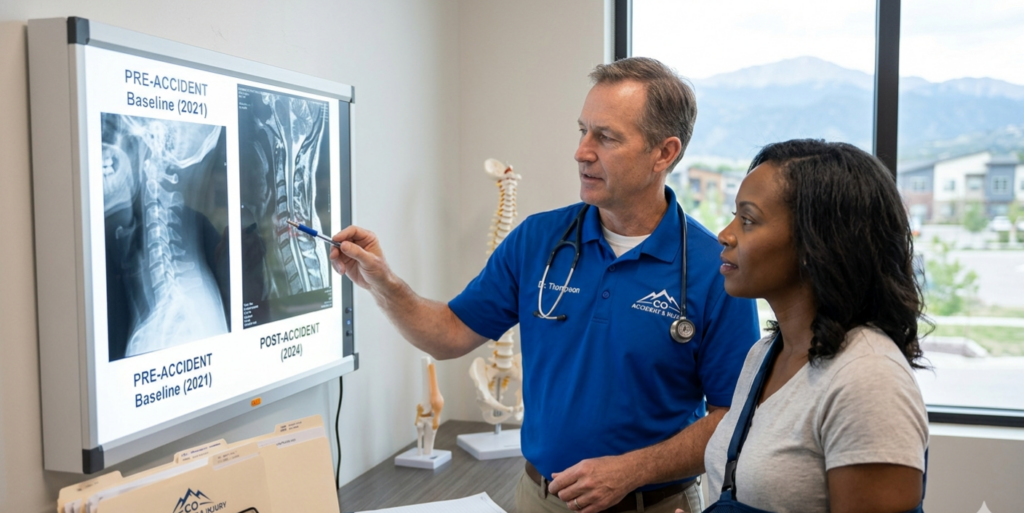
The key to winning a case involving a prior injury is showing the “before and after.” This is why Best Physical Therapy Services are so critical early on. We work to establish what your functional baseline was before the accident—what activities were you able to do? How often were you seeking treatment? By comparing your pre-accident mobility to your post-accident limitations, we create a clear picture of the damage caused by the collision.
4. The Risk of Non-Disclosure
One of the fastest ways to ruin a personal injury claim is to hide a pre-existing injury. Insurance companies have access to vast databases of medical and claims history. If they discover a prior injury that you didn’t disclose, they will use it to destroy your credibility. When you are honest about your history, we can use Chiropractic Care to specifically isolate the new misalignments and soft tissue damage caused by the crash.
5. Using Diagnostic Imaging to Prove New Trauma
While symptoms may overlap, diagnostic imaging often tells a more detailed story. Modern MRI and CT scans can sometimes distinguish between “chronic” (old) changes and “acute” (new) trauma. For example, “edema” or swelling in the bone or soft tissue is a clear indicator of recent injury. At Colorado Accident & Injury, we utilize these high-level diagnostics to provide the objective proof your legal team needs.
6. Managing the “Pain Reset”
For many patients, a car accident can “reset” their progress. Someone who had successfully managed their chronic pain through Pain Management might find that the trauma of a crash makes those previous treatments ineffective. We recognize that your recovery timeline may be longer because of your history, and we design our treatment plans to account for that added complexity.
7. Why Expert Medical Testimony is Essential
In cases involving pre-existing conditions, the insurance company will almost certainly hire their own medical “expert” to claim your pain is purely age-related or pre-existing. You need an opposing expert who actually knows your case. Our providers can offer the detailed testimony and clinical notes required to explain exactly how the accident caused a “new” layer of disability on top of your old one.
8. Documenting the “Daily Life” Impact
Do pre-existing injuries impact personal injury claims? They do when they rob you of the progress you had already made. If you were finally able to play with your grandkids or return to work after an old injury, and the accident took that away again, that loss is compensable. We encourage our patients to keep a “symptom diary” that we then correlate with our clinical findings to show the true human cost of the accident.
9. Colorado’s Legal Landscape
Colorado law is protective of victims with prior conditions, but it requires precise medical evidence to trigger those protections. Our team is well-versed in the specific documentation standards required by Colorado courts. We work hand-in-hand with your attorney to ensure that your “pre-existing” status is treated as a factor that increases the defendant’s liability, not a loophole for them to escape it.
Don’t Let Your History Stand in the Way of Your Future Your past injuries don’t define your right to a healthy, pain-free life today. Our integrated team is ready to help you untangle the complexities of your claim and provide the expert care you need to move forward.